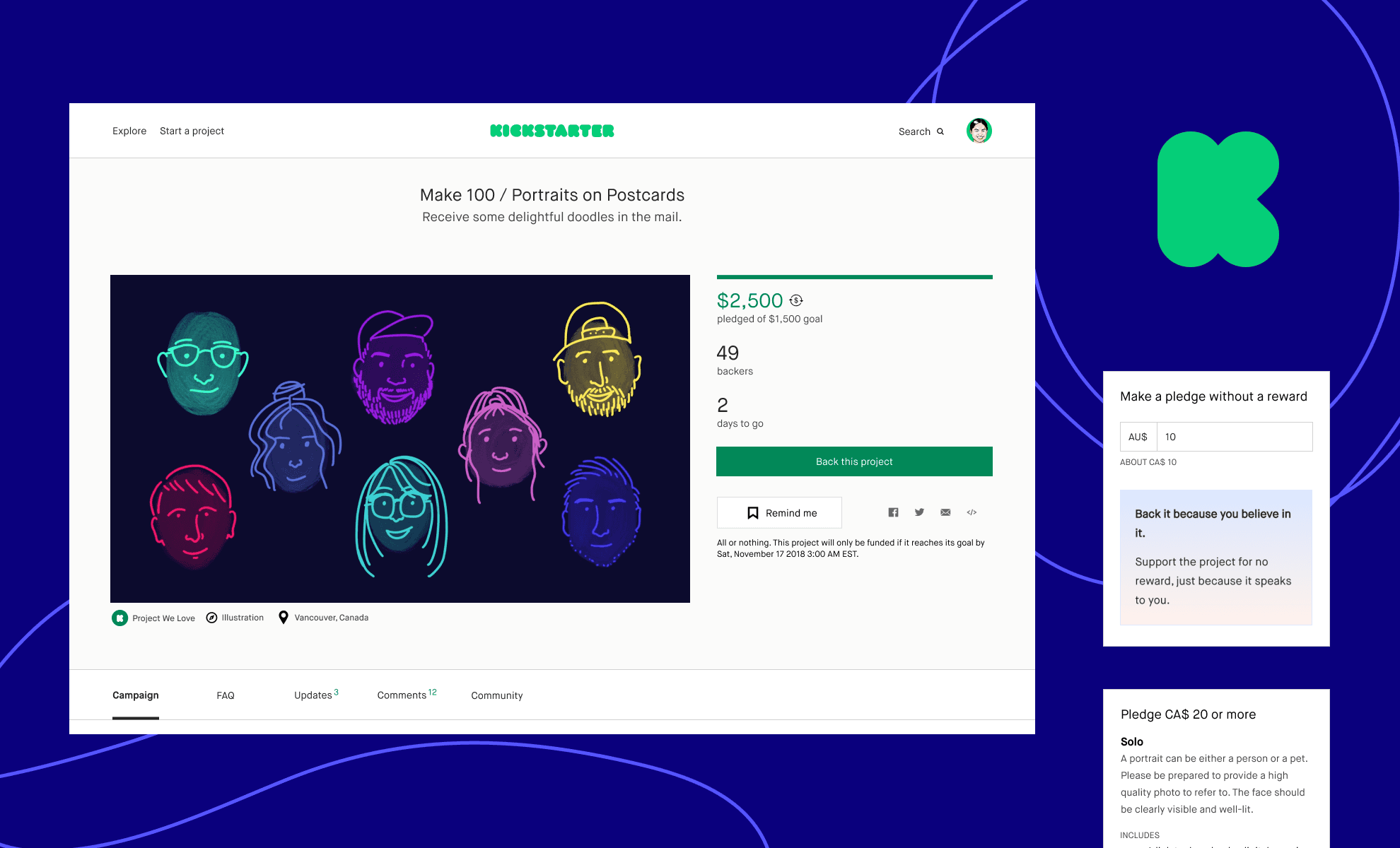
Problem
Kickstarter was built for the funding moment. That part worked smoothly but once the campaign hit its goal, creators were handed a spreadsheet, a lump sum, and no tools for what came next. They had to either manually handle or use a third-party product for tracking who wanted what, coordinating production, and ultimately fulfilling orders to hundreds or thousands of backers. A backer who simply wanted to add an extra item to their pledge had to message the creator directly. The creator would note it somewhere, try to reconcile it against their export, and hope nothing fell through the cracks. It was a workaround masquerading as a process, happening across thousands of projects.
My role
Senior product designer on the Rewards and Fulfillment team. We had one engineering squad, a PM, and me as the designer. I mapped the full lifecycle of a Kickstarter project at every stage, every actor, every handoff, every place where something could break. Kickstarter had been running for over a decade, and the systems were interconnected in ways that weren't visible from the surface.
Three decisions that shaped the work
Invitation, not upsell
Kickstarter is a Public Benefit Corporation. Its measure of success isn't profit, it's whether creative projects reach the world. Add-ons had to feel intentional rather than conversion-driven. That distinction shaped everything from information hierarchy to the language on the confirmation screen.
Phased rollout into a fragile system
We were building into a decade-old platform where a change to the backer experience could ripple into creator workflows, survey logic, and fulfillment exports simultaneously. We moved through concept experiments, usability tests, beta, then full rollout — with each phase a check against the complexity underneath.
Build for the creator's real workflow
Creators were already managing add-on requests manually through messages, spreadsheets, and improvised tracking. The feature needed to absorb that existing behavior into something structured, not ask creators to abandon what they'd figured out and start over.
Outcome
Add-ons gave creators and backers a structured way to adjust pledges after funding, without relying on spreadsheets and one-off messages.
Padded shoulder belt
CAD$ 25
Add-on reward
Ships to anywhere in the world | Estimated delivery Jul 2026
Includes
1 Padded shoulder belt

Pledges per project
5 - 8.5%
average increase in pledges per project for creators using add-ons
Total project revenue
11 - 17%
increase in total revenue for projects using the feature
Pledges with add-ons enabled
22%
of all pledges included an add-on — surpassing the 15% goal